
3 min read ·
A Tennis Court Is 78 Feet Long—Here’s What Each Line Measures
A tennis court is 78 feet (23.77 m) long. See singles and doubles widths, service-line distances, net height and recommended surrounding space.
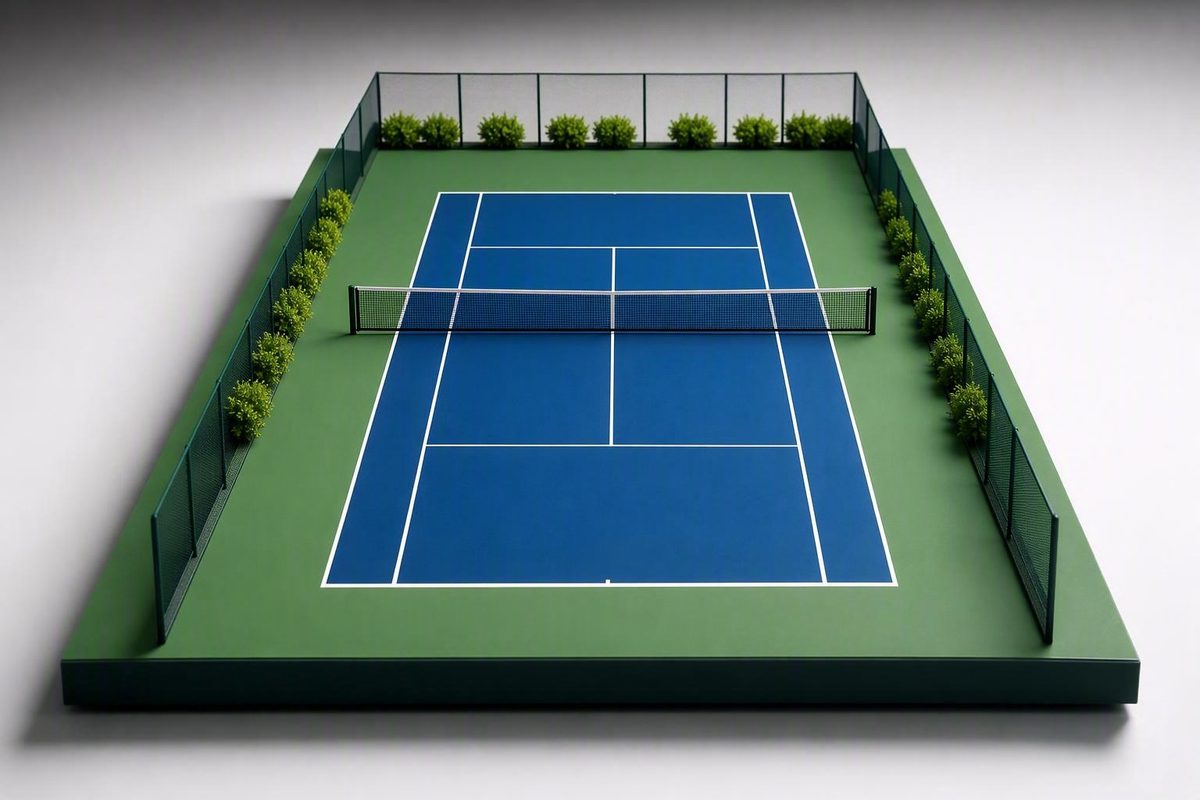
A regulation tennis court is 78 feet (23.77 metres) long from baseline to baseline. The net divides that length evenly, so each baseline is 39 feet (11.885 metres) from the net.
The length is the same for singles and doubles. What changes is the width: 27 feet (8.23 m) for singles and 36 feet (10.97 m) for doubles, as specified in the 2026 ITF Rules of Tennis.
| Court measurement | Feet | Metres |
|---|---|---|
| Full length, baseline to baseline | 78 | 23.77 |
| Baseline to net | 39 | 11.885 |
| Singles width | 27 | 8.23 |
| Doubles width | 36 | 10.97 |
| Net to service line | 21 | 6.40 |
| Each doubles alley | 4.5 | 1.37 |
How the 78-foot length is divided
The net sits at the midpoint of the court. On each side, the service line is 21 feet (6.40 m) from the net. That leaves 18 feet between the service line and baseline on each end. The ITF states that the service lines run between the singles sidelines and that the centre service line divides the area into two equal service boxes.
In sequence, the court’s length is:
18 feet from baseline to service line + 21 feet to the net + 21 feet to the other service line + 18 feet to the opposite baseline = 78 feet.
This layout helps put serve data in context. A serve must travel over the net and into the diagonally opposite service box; “21 feet” describes the box’s depth from the net, not the full flight of the ball. Serve speed, contact height, angle and placement all affect the actual trajectory. For more on interpreting pace, see how fast a professional tennis serve is.
Singles and doubles use the same length
Both formats use the full 78-foot baseline-to-baseline distance. Doubles adds two alleys, each 4.5 feet (1.37 m) wide, producing a 36-foot-wide court instead of the 27-foot singles court. The marked playing areas are therefore:
- Singles: 78 × 27 feet, or 2,106 square feet (about 195.7 m²)
- Doubles: 78 × 36 feet, or 2,808 square feet (about 260.9 m²)
Measurements are taken to the outside edge of the lines, according to the ITF rules. A ball touching a boundary line is consequently treated as touching the court enclosed by that line.
Court length is not the same as required site length
The 78-foot figure covers only the marked court. Players also need run-off room behind the baselines and beside the sidelines. For international competition, ITF guidance recommends at least 21 feet (6.40 m) between each baseline and backstop and 12 feet (3.66 m) between each sideline and sidestop. Applying those recommendations to a doubles court gives a minimum overall footprint of 120 × 60 feet, although venue requirements can vary. The distinction matters when measuring space to build or enclose a court rather than simply checking its playing lines.
One other useful reference point is net height: the official net is 3 feet (0.914 m) high at the centre and 3.5 feet (1.07 m) at the posts. That central dip helps explain why serves and rally balls crossing near the middle encounter a lower obstacle than shots directed closer to the sideline.