
4 min read ·
Tennis scoring history: what we know about 15–30–40
Trace tennis scoring from medieval 15–30–45 to modern tiebreaks, separate origin myths from evidence, and see why scoring rules shape match records.
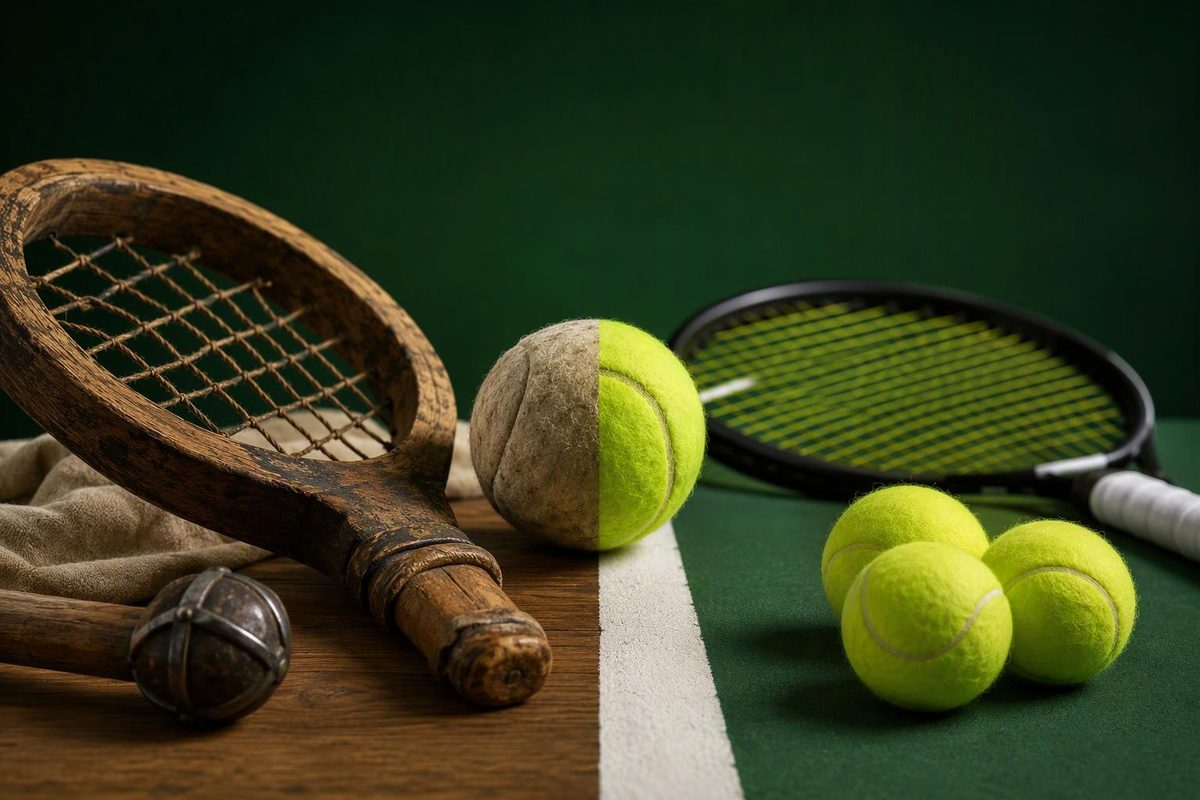
Tennis scoring has two different histories: the uncertain origins of love, 15, 30 and 40, and the well-documented changes that made sets more predictable in length. The familiar clock-face explanation belongs to the first category—not established fact. The introduction of Grand Slam tiebreaks in 1970 belongs to the second.
The distinction matters when reading match statistics. Changing how a set ends changes how many service games, aces and pressure points players can accumulate.
Why 15, 30 and 40?
The numbers are score labels, not points awarded in batches. Under standard advantage scoring, winning one point takes a player to 15, two to 30 and three to 40. A fourth wins the game unless both players have reached three points each: deuce. From deuce, a player needs two consecutive points to win. The server’s score is called first. These are the definitions in the ITF’s 2026 Rules of Tennis, Rule 5.
The sequence predates lawn tennis. Medieval tennis, associated with the French jeu de paume, used 15, 30 and 45. Fifteenth-century poems refer to those scores; Erasmus also used 30 and 45 in a sixteenth-century dialogue between tennis players. As TIME’s history, drawing on tennis historians Elizabeth Wilson and Heiner Gillmeister, explains, even early writers questioned why one successful stroke counted as fifteen.
Why did 45 become 40? TIME cites Gillmeister’s account of French students shortening the spoken score from 45 to 40. That supports abbreviation as a historical practice, but it does not establish one definitive moment or reason for the change.
The popular clock theory imagines four quarter-turns: 15, 30, 45 and 60. Its difficulty is chronology: references to the scoring sequence precede the widespread use of minute hands. It is a memorable explanation, not a proven origin. The same historical account describes several competing theories without treating any as settled.
“Love” and “deuce”: meaning is clearer than origin
Love means zero. The often-repeated explanation that it comes from French l’œuf, “egg,” because an egg resembles a zero is disputed. TIME’s account notes both the lack of evidence that French players used l’œuf for tennis scores and Gillmeister’s linguistic objections. Other explanations connect love with playing for nothing or with a word meaning honour. None should be presented as certain.
Deuce has a clearer connection with French deux, “two,” although the precise route into tennis terminology is less clear. Its practical meaning is unambiguous: after deuce, two consecutive points are needed to finish a standard game. Historical terminology account
Lawn tennis kept the old labels; tiebreaks changed the finish
The first Wimbledon Championship in 1877 helped establish lawn tennis using the older 15–30–40 scoring sequence. Modern tennis therefore inherited the unusual labels rather than inventing them. TIME’s account of lawn tennis’s development
The consequential later changes concerned tied sets:
- 1970: The US Open became the first Grand Slam to use tiebreaks. Jimmy Van Alen’s nine-point “sudden death” version was won by the first player to five points. At 4–4, one point settled the set—no two-point margin was required.
- 1975: The US Open replaced that format with the version now commonly described as first to seven, win by two. Contemporary terminology called it a “12-point tiebreak,” but twelve was not a maximum: play continued if necessary to obtain the two-point margin.
Both changes are documented in the US Open’s history of the tiebreak.
In 2022, the four majors jointly introduced a ten-point tiebreak at 6–6 in deciding sets, initially as a trial beginning with Roland-Garros. In major singles, the winner must reach at least ten points and lead by two. This is different from a match tiebreak, which replaces the entire deciding set in some formats. The Grand Slam announcement explains the change; the 2026 ITF rules, Appendix VI, distinguish the two procedures.
An advantage set has no tiebreak: players must win at least six games and lead by two games. Isner–Mahut at Wimbledon shows what that could produce.
Records table
| Record | Holder | Value | Date or season | Source |
|---|---|---|---|---|
| Longest professional tennis match | John Isner–Nicolas Mahut | 11 hours, 5 minutes | Wimbledon, 22–24 June 2010 | Guinness World Records |
| Most games in a tennis match, as recorded in 2010 | John Isner–Nicolas Mahut | 183 games | Wimbledon, 22–24 June 2010 | Associated Press via ESPN |
| Most games in a tennis set, as recorded in 2010 | John Isner–Nicolas Mahut | 138 games; fifth set finished 70–68 | Wimbledon, 23–24 June 2010 | Associated Press via ESPN |
Those records reflect both sustained serving and the absence of a fifth-set tiebreak. Isner won 6–4, 3–6, 6–7, 7–6, 70–68, but Mahut won more total points: 502 to 478. The contemporary match report also records 168 consecutive service holds before the decisive break.
What scoring history changes about the statistics
Tennis rewards points grouped into games and games grouped into sets—not the largest match-wide point total. Mahut’s numbers are a particularly clear example: winning more points did not mean winning the required sets.
Scoring formats also determine opportunity. An advantage-set marathon can offer far more chances to collect aces than a deciding set settled by a tiebreak at 6–6. For comparisons, record the surface, match format and deciding-set rule alongside the total, then distinguish volume from rate. Our guide to career aces versus ace rate explains that denominator problem; the longest Wimbledon match analysis applies it to Isner–Mahut.
A tiebreak limits the extension in games, not necessarily in points or minutes: win-by-two scoring can still continue beyond seven or ten. And a dramatic scoreline describes what happened. On its own, it does not measure mental strength.